
SBTi
SBTi in Korea
Science Based Targets initiative
The Science Based Targets initiative (SBTi) is a global corporate climate action organization that develops
standards, tools, and guidance for companies and financial institutions to set science-based greenhouse gas
emissions reduction targets and net-zero targets. Through SBTi Services, the organization also validates targets against rigorous criteria.
KoSIF supports Korean companies and financial institutions in understanding SBTi standards, setting science-
based targets, and preparing for target validation through SBTi Services. Through these efforts, we contribute to
more credible climate action in Korea by aligning corporate and financial institution targets with global science-
based standards.
Why SBTi Matters in Korea
Ambitious Corporate Climate Action
A Global Standard for Credible Climate Action
To limit global warming to 1.5°C above pre-industrial levels, companies and financial institutions need credible emissions reduction targets aligned with the latest climate science.
For Korean companies and financial institutions, science-based targets are becoming increasingly important as global customers, investors, and financial markets demand more credible climate action and transition plans. SBTi provides a globally recognized framework for setting emissions reduction targets consistent with the goals of the Paris Agreement.
By supporting SBTi participation in Korea, KoSIF helps companies and financial institutions strengthen the credibility of their climate targets and align their transition efforts with global science-based standards.
SBTi and Climate Targets
* Based on Version 1.3.1, applicable to target submissions through January 2028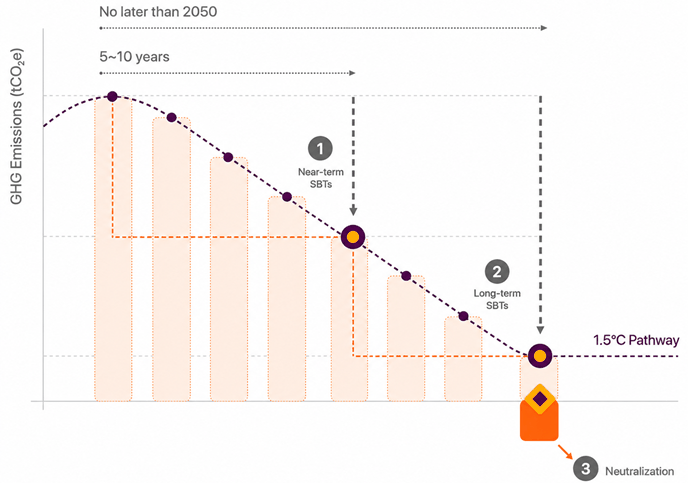
-
1
 Near-term SBTs
Greenhouse gas emissions reduction targets that companies aim to achieve within 5 to 10 years from the date of submission to SBTi, in line with a 1.5°C pathway.
-
2
Long-term SBTs
Long-term science-based targets define the emissions reductions needed to reach net-zero no later than 2050, in line with a 1.5°C pathway.
-
3Neutralization
The permanent removal and storage of carbon to neutralize residual emissions that remain after long-term science-based targets are achieved.
-
 Net-Zero Target
A target that combines near-term and long-term science-based targets with the neutralization of residual emissions in the net-zero target year and thereafter.
SBTi Progress in Korea
* As of June 2026Korea
-
Near-term Commitments
22
Near-term Targets Set
80
Net-zero Commitments
11
View SBTi Participants in KoreaNet-zero Targets Set
18
Global
-
Near-term Commitments
2,408
Near-term Targets Set
11,156
Net-zero Commitments
1,135
View Global SBTi ParticipantsNet-zero Targets Set
2,608
SBTi Target-Setting and Validation Process
-
 REGISTER
Register in the SBTi Services
Validation Portal -
 COMMIT
Commit to submitting
science-based targets
within 24 months -
 DEVELOP
Develop a GHG inventory
and set reduction targets
per SBTi standards -
 SUBMIT
Submit targets for
validation through
SBTi Services -
 COMMUNICATE
Publicly communicate
validated targets
to stakeholders -
 DISCLOSE
Annually disclose progress
on emissions reduction
and implementation
For guidance on SBTi participation and target-setting, please contact KoSIF.
 Contact